Fire, Water, and the Space Between
A Studio Conversation
When a fellow artist walks through your exhibition, something different happens. They aren't just seeing — they're reading. Recently, my friend Liz Krewson, a graphic designer and art director with a remarkable eye for color, joined me at my current show. What unfolded was one of those rare conversations where someone else's words illuminate your own work in ways you hadn't yet found language for.
We talked about three paintings: Gossamer Wings, Fire and Bloom, and End of Summer. What follows is drawn from that exchange — a meditation on paradox, on layers, on the coexistence of fire and water, bitterness and sweetness, in paint and in life.
Gossamer Wings
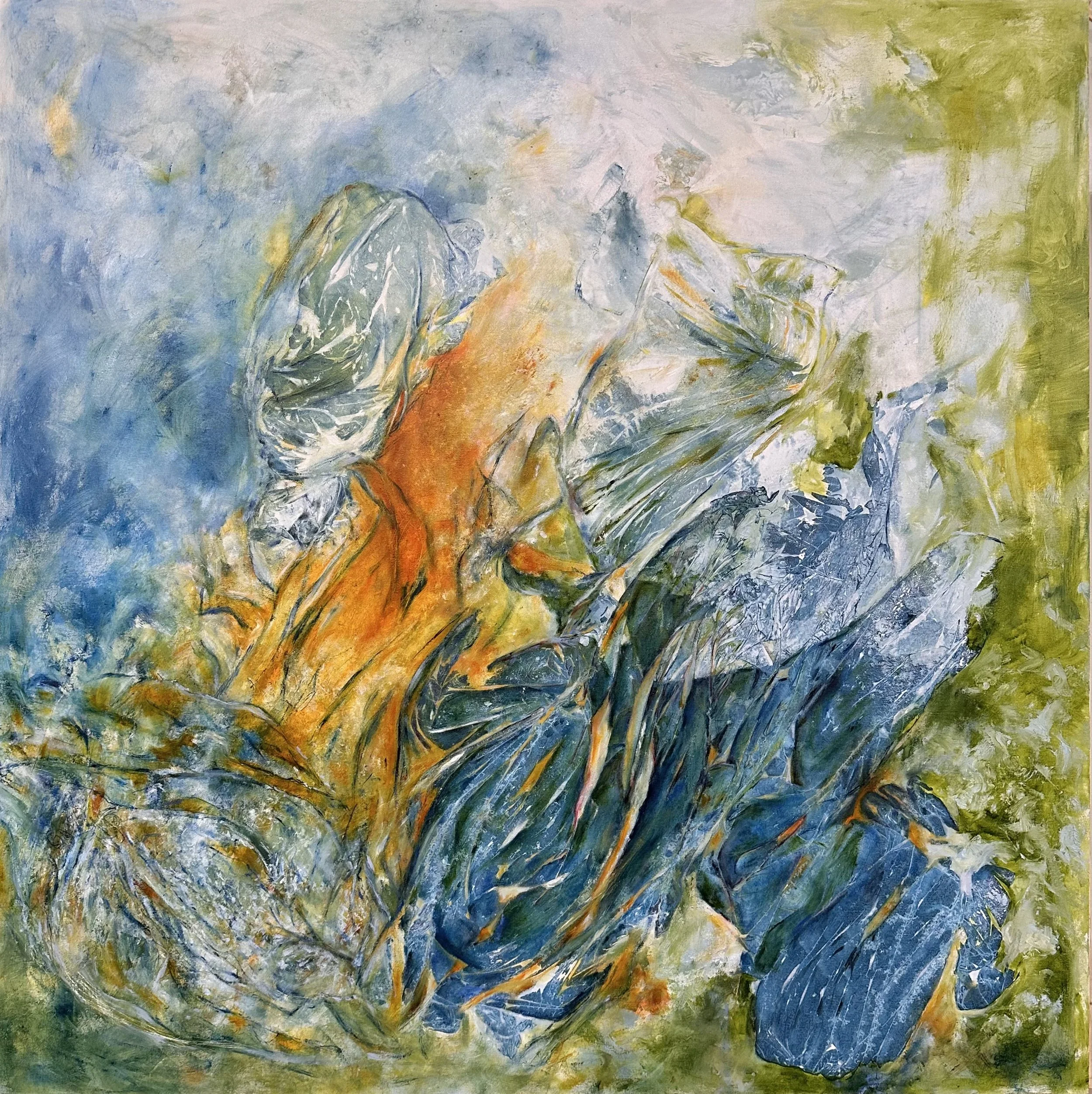
“Gossamer Wing”s 48 × 48” Oil glazing on Acrylic subpainting on canvas
"I see shapes that are elegant and refined — but they're not fragile, and they're not fussy, and they're not static. And I think that's an achievement." — Liz Krewson
Liz drew an analogy that stayed with me: singing a high note quietly. The difficulty isn't just reaching the pitch — it's holding it with restraint, loud enough to be heard but no louder. She sees Gossamer Wings as that kind of accomplishment: the refinement of drawing brought into the energy of paint without either quality suffocating the other.
"A lot of times when you see things that are elegant and refined, they can be a little bit fussy and a little bit static," she said. "That's not at all what's happening here. This is still dynamic and energetic, but refined and incredibly elegant — all with that same energy."
The color was what gave her that reading most powerfully. The greens, the blues, those ice-toned passages — and yet, she said, it still feels warm. Water, and ice, and fire all at once. It's a contradiction I've been drawn to for years: how opposing forces don't cancel each other out. They coexist.
Fire and Bloom
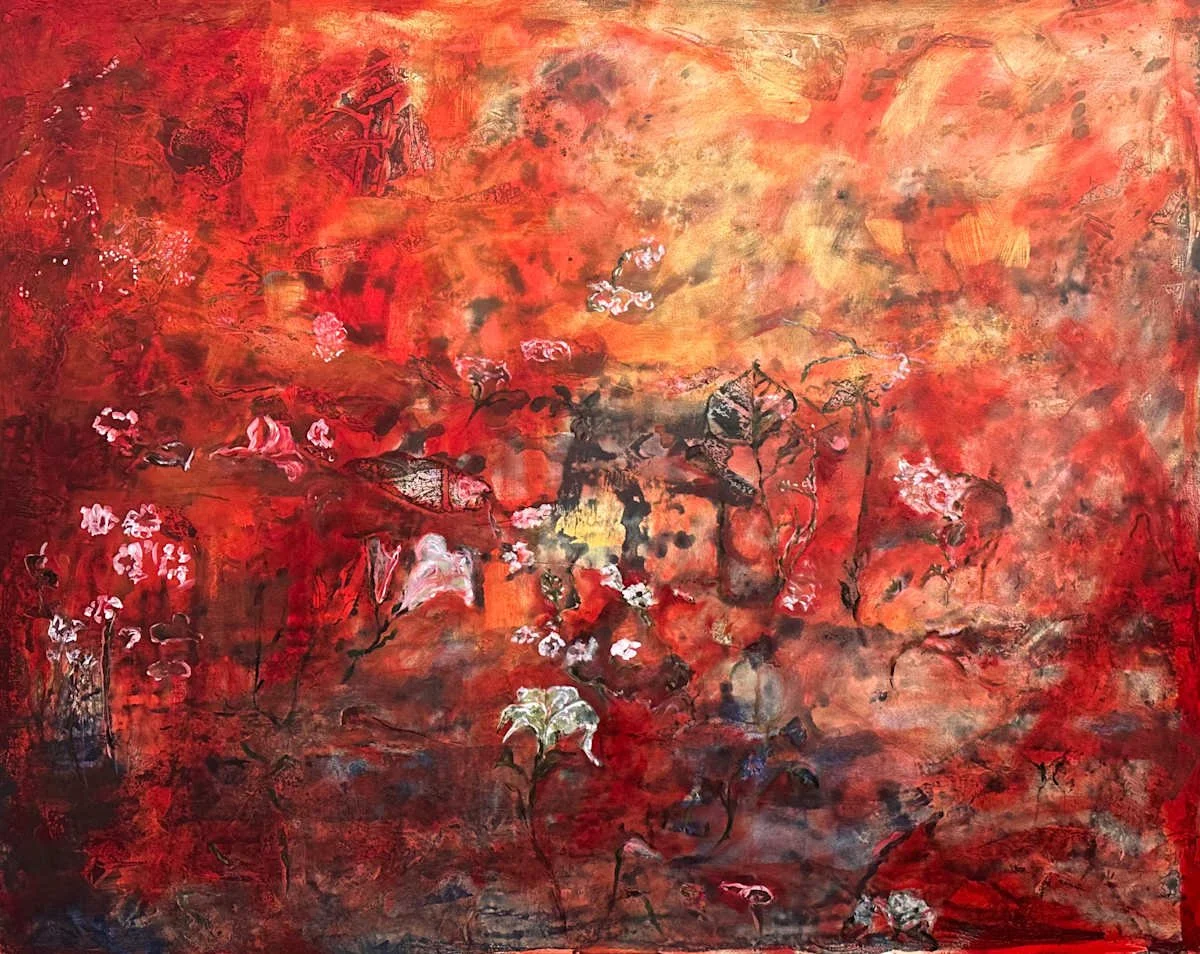
Fire and Bloom 48 × 60” Oil glazing on Acrylic sub painting
"It could be atmosphere. It could be water. A branch with flowers on it, partly submerged and partly right at the surface. You're looking through, and there — at the edge — is something alive." — RC
This painting developed over a long time, layer upon layer of glazing, objects drawn and frozen at different levels of the picture plane. Because of the layers of glazing, colors and objsects recede and then come forward, and surfaces shift as the light changes. Liz made a connection to Paul Klee: she recalled his floating fish in a painting. Here, there is the same sense of things both clearly delineated and pulled back into abstraction.
The reds and golds dominate. And yet underneath, in very few places, there is a deep dark blue — a navy so shadowed that most viewers don't register it as blue at all. Liz, with an art director's color acuity, found it immediately. “That felt right to me. ‘ , Liz said, “The water is there. It doesn't announce itself. It simply is.”
What Liz noticed was how the identifiable elements — a leaf, a flower, a branch — function as entry points. You recognize them, and that recognition becomes a doorway. "The representative items invite you to look more closely," she said, "because you don't have to work to understand what they are. They're a window into the rest of the painting."
There is a yellow shimmer in the background — a warm glowing spot that both of us kept returning to. It looks far away, even though yellow is a color that typically leaps forward. "It looks like you're looking through a hole in the foliage," Liz said. "A hidden garden. A place you're invited to go."
That's the paradox I keep painting: the place that draws you in is also the place that keeps its distance.
End of Summer

"End of Summer" 48 x 60" oil layered on acrylic subpainting
"I see different things coming forward and different things receding. And floating — there's a lot of floating. But there's so much energy in these paintings. It's just remarkable." — Liz Krewson
“This painting transmits the force of the ocean.” Liz kept returning to the sense that looking at this painting is like looking into water: you can see the surface, and then you can see through it. The layering doesn't just create visual depth — it creates an invitation. "You're asking the viewer to look deeper," she said.
That quality — whether it be water, thick atmosphere, or the gauze of a dream — runs through all of these paintings. The sensation of seeing through, of something recognizable existing just beyond what you first notice, A flower glimpsed as it moves through the current, a branch caught between worlds.
A latent sweetness
Liz is a Buddhist, and she offered a teaching mid-conversation that I haven't been able to stop thinking about. A persimmon picked on a cold gray day, before it's ripe, will be bitter. But wait for the sun and the warm wind, and that same fruit — the exact same one — becomes sweet. Nobody scooped out the bitter and filled it with sweet. The sweetness was always there, latent, waiting for the right conditions.
Enlightenment, she said, is like that.
That's what I keep painting. The fire that doesn't extinguish in the water. The warmth inside the ice. The hidden garden behind the yellow shimmer. All of it present, all of it real, each element a latent aspect of the other — waiting for the right light to come forward.
I'm grateful to Liz for helping me see it so clearly.
The exhibition is currently on view. The gallery is open 9-4 M-F. I’ll be happy to meet you there! Just reach out, and we will make a plan!